
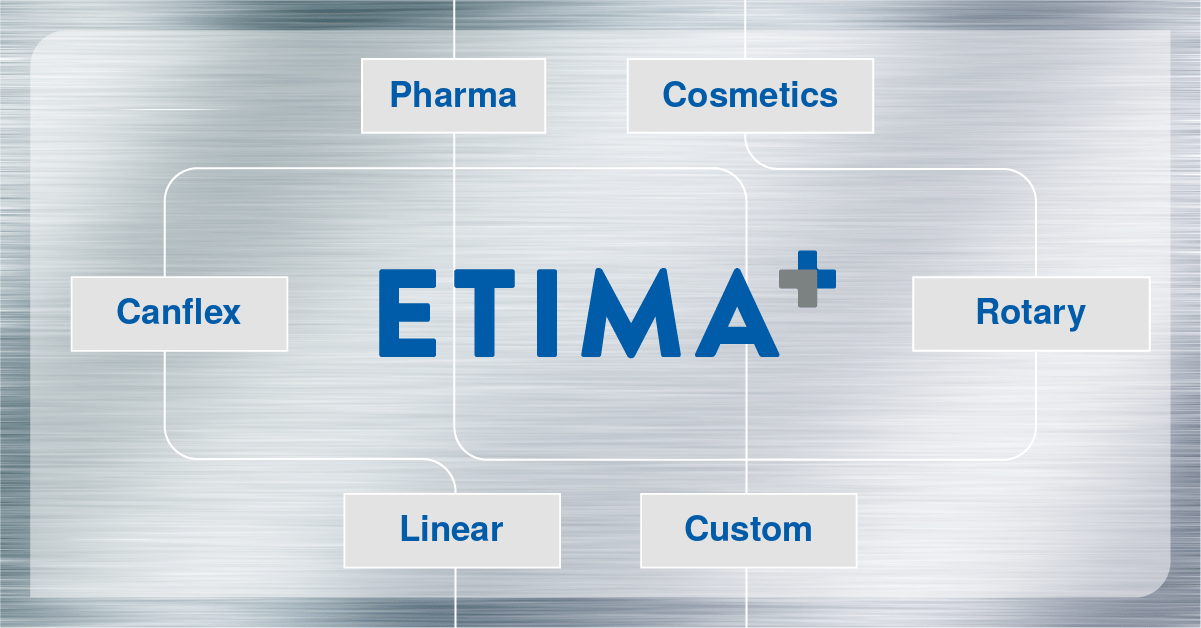
A labelling machine is not an isolated piece of the production process: it conditions throughput, cost per unit, the final quality of the product and, in regulated sectors, traceability and regulatory compliance. That is why Etima’s industrial labelling machines portfolio has not been built as a closed catalogue, but as a network of solutions that coexist and complement each other: standard platforms, lines such as Etima CANFLEX for changing mix, and custom-designed machines when the container does not resemble anything known.
One solution per sector and per container, not a closed catalogue
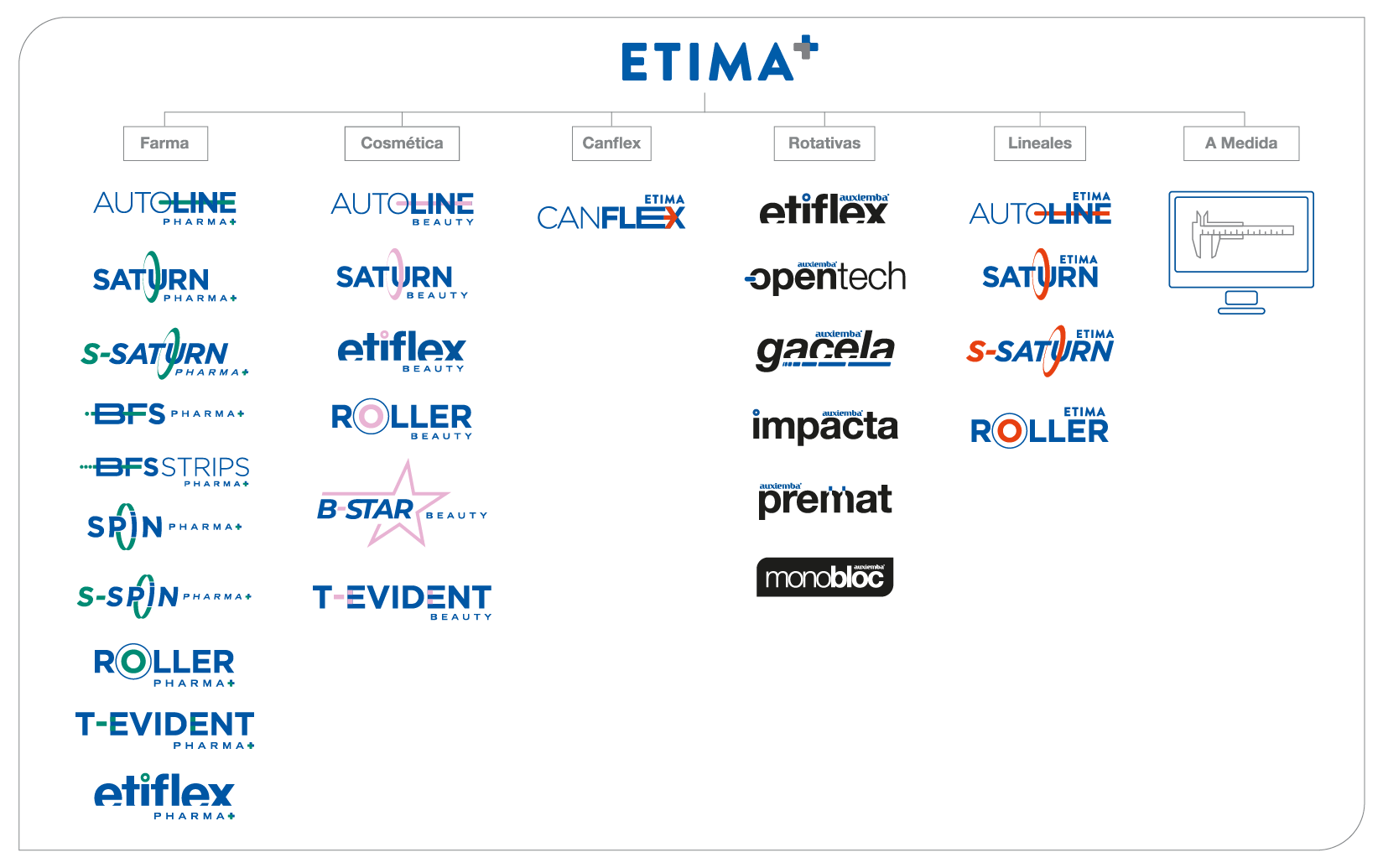
Etima’s portfolio covers the main sectors of industrial packaging: pharmaceutical, cosmetics, food and beverages, canning and chemical. And it also covers the diversity of containers that each sector demands: cylindrical, oval, premium bottles, squeeze formats and special formats that do not fit any standard category.
This breadth is not managed from a fixed catalogue. Whenever a new container appears, the R&D team turns it into a viable project: either an existing proven platform is adapted, or a specific labelling machine is designed for that challenge. The criterion is the same in both cases: that integration on the plant floor is clean, that the start-up is predictable and that the labelling is stable from the first batch.
This approach has a name within Etima: Efficient Evolution. Three ideas support each other. Precision for today, adaptability for tomorrow, and a partner relationship that does not end when the machine goes into production.
When to choose rotary, when to choose CANFLEX, when custom
The portfolio responds to three different logics depending on the real demands of each production line.
When demand is stable and throughput requires high performance, a well-designed rotary platform protects cost per unit. It is the usual option for high-volume productions where the container does not vary and the priority is to minimise downtime.
When the container mix changes frequently, Etima CANFLEX provides the elasticity that prevents revisiting decisions every quarter. It is a line designed for scenarios in which the client’s portfolio evolves and the labelling machine has to evolve with it, without forcing investment in a new machine every time.
When the container does not resemble anything known, or when plant conditions demand a specific response, the path is a custom machine. The process begins with an analysis of the container and the production environment, and ends in a validated solution that can later become a platform for other clients facing similar challenges.
It is not about ranking paths. The three logics coexist within the portfolio because none of them serves every scenario. Conversation with the client, before conversation with the machine, defines which option is right.
Pharma and cosmetics: two demands within the same portfolio
The pharmaceutical and cosmetic sectors share some needs but diverge in others. The portfolio addresses both demands without treating them as two separate catalogues.
In pharma, what makes the difference is evidence. Qualification documentation (DQ), factory and site acceptance tests (FAT and SAT), installation and operational qualifications (IQ/OQ) and traceability available from day one. They are not procedures added at the end of the project: they are integrated into the process from design, so audits find the material already prepared. For particularly sensitive containers, the portfolio includes specific solutions such as machines for BFS strips or ophthalmic containers, where speed and precision must coexist with container integrity.
In cosmetics, the priority changes in nature: the container builds the brand. The precision of positioning, the quality of the finish and the care of the process are part of what the end consumer perceives when picking up the product. A poorly applied label on a premium bottle is not an industrial defect: it is a loss of brand value. That is why platforms designed for this sector prioritise repeatability and process care, without sacrificing the throughput the operation requires.
Three questions that help decide
Before choosing a labelling machine, there are three questions worth asking. They are the ones that, according to Etima’s experience, best anticipate how the machine will behave once in production.
How many real hours does the equipment need to reach stable nominal speed? The catalogue’s theoretical speed does not always match reality. A clear answer here avoids surprises in the production plan.
What waste will be seen in the first batches? Every new line generates initial waste, but the reasonable range depends greatly on design and commissioning quality. Knowing what to expect makes it possible to plan raw materials and commercial commitments.
What support is there if the container evolves? Packaging changes. When it does, the question is not whether the labelling machine will be able to adapt, but what kind of support the manufacturer offers so that the adaptation is predictable and economically viable.
When those three answers are clear, the decision about which labelling machine to choose becomes much simpler. And the choice stops being a one-off purchase and becomes a medium-term relationship between client and manufacturer.
That is what defines the Etima portfolio: a living system of industrial labelling machines designed to accompany each client through their real scaling, not the one in the catalogue. Do you have a labelling project and want to know which solution best fits your container and sector? Tell us what you are working on and we will propose the way forward.