Pharmaceutical Packaging
At ETIMA+, we are specialize in labelling for the pharmaceutical sector, covering a wide variety of formats and sizes. Our high quality standards and extensive industry knowledge ensure the inspection and data management necessary to meet the requirements of your project.


Frequently asked questions
The same standards as any industrial machine and, on top of that, a level of documentation that no other sector requires.
Our machines comply with the Machinery Directive 2006/42/EC, the Low Voltage Directive 2014/35/EU and the Electromagnetic Compatibility Directive 2014/30/EU. In the pharmaceutical field they also comply with Annex 15 of the EU GMP and, when the project requires it, with FDA 21 CFR Part 11.
We follow the GAMP 5 guidelines, the good practice guide that enables us to meet these regulations. The qualification documentation we deliver with every machine is the best evidence of that level of compliance.
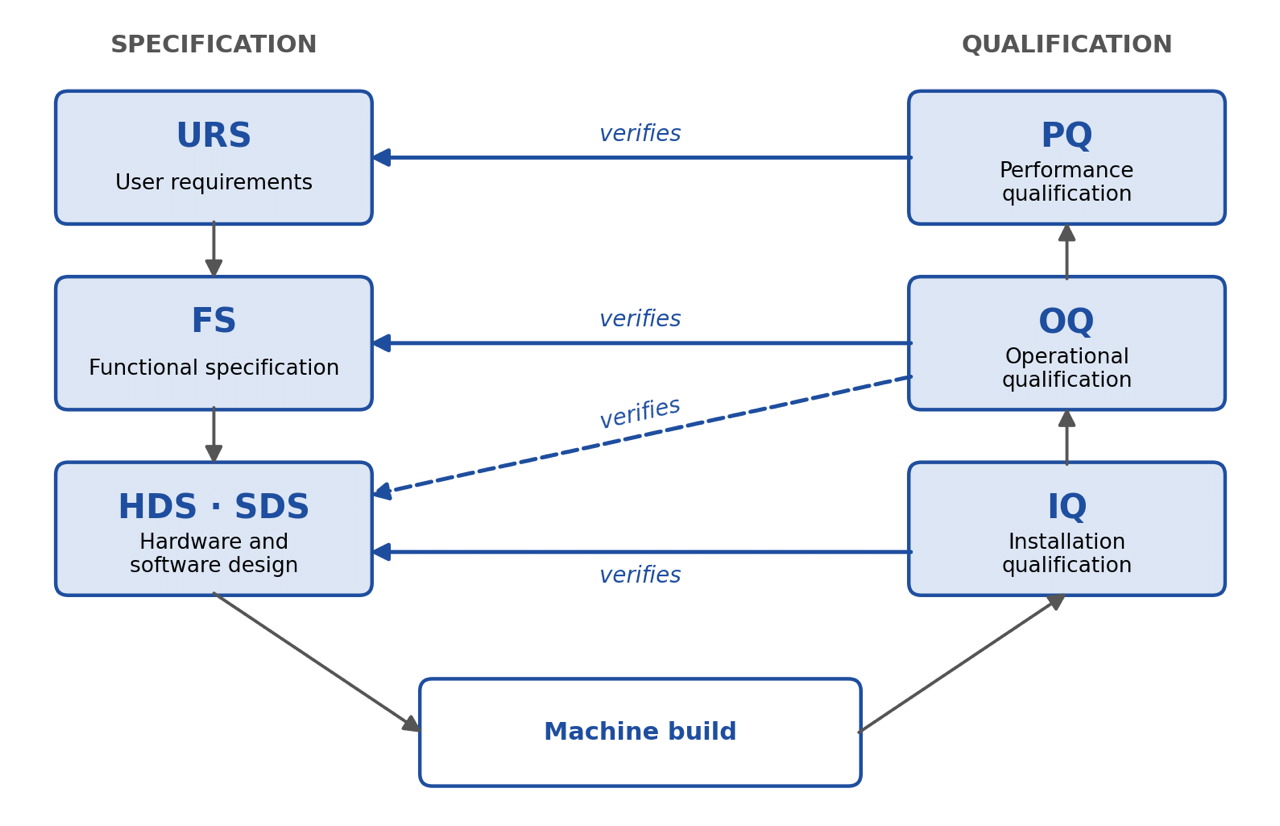
They are the three qualification stages that prove the machine does what it was asked to do: IQ (Installation Qualification), OQ (Operational Qualification) and PQ (Performance Qualification).
Before reaching them, the machine is defined in other documents. The URS (User Requirements Specification) sets out the customer’s requirements. The FS (Functional Specification) describes how the machine will work. The HDS (Hardware Design Specification) defines the components and how they are interconnected. And the SDS (Software Design Specification) defines the logical operation of the computer systems.
The diagram shows how everything fits together. The documents that define the machine (FS, HDS and SDS) are developed from the URS, the machine is built from them, and then each qualification stage verifies one level: IQ checks the design (HDS and SDS), OQ checks the functional specifications (FS) and also the design (HDS and SDS), and PQ checks the customer’s requirements (URS).
Yes, and that is the most common case. Drop-in integration means fitting the labelling station into the existing line while respecting its pitch, conveyor height and communication protocol. There is no need to redesign the whole line, and the plant stops for far less time than if the entire line were replaced.
This is one of the areas where a flexible manufacturer makes a difference. We adapt the machine to the line that already exists instead of asking the line to adapt to a catalogue unit, even when that means redesigning the frame, the direction of travel or the working height.
Thirteen: vials, ampoules, syringes, carpules, autoinjectors, bottles, bottles with serter or booklet, cartons, ophthalmic products, mouthwash bottles, unstable containers and the two Blow-Fill-Seal formats, strips and bottles. Each one has its own page, because each one is held, oriented and labelled in a different way.
Verification of label presence and position using machine vision, reading and quality grading of the printed code, and automatic rejection of any non-compliant container into a segregated, access-controlled bin.
Every reject is logged with its reason. That record is what makes it possible to reconcile units, as regulated production requires.
Yes, but always outside the tray. RTU containers, such as vials or syringes, arrive already sterilised and presented in nest and tub format, arranged in a tray rather than in bulk. That simplifies part of the job, because each unit arrives in a known position and does not need orienting.
In return, it complicates another part: they are not labelled inside the nest. Each unit has to be removed from the tray, labelled and put back.
Serialising means assigning each pack a unique identifier that allows it to be tracked throughout the supply chain, as required by Commission Delegated Regulation (EU) 2016/161. The labelling station is where that code is printed and then read to check that it is correct and legible. If verification fails, the unit is rejected on the spot.
In Spain, the data is uploaded to the national repository managed by SEVeM, which is connected to the European system. The labelling machine is the physical point where the data stops being a record and ends up on the pack, which is why print quality and in-line verification matter so much.
Do you need a bespoke labelling machine?
Tell us about your idea and we will manufacture the perfect labelling machine.